Selecting the right travel lift capacity is one of the most important engineering and operational decisions for any marina, shipyard, or boatyard handling yachts and fishing boats. Whether you are lifting a 30-foot fishing vessel or a 100-foot luxury yacht, the wrong capacity choice can lead to equipment overload, safety risks, structural damage, and unnecessary operational costs.
In this article, we will break down how to accurately determine the required travel lift capacity, what factors influence lifting weight, and how to match different boats with suitable lifting systems.
1. What Is a Travel Lift and Why Capacity Matters?
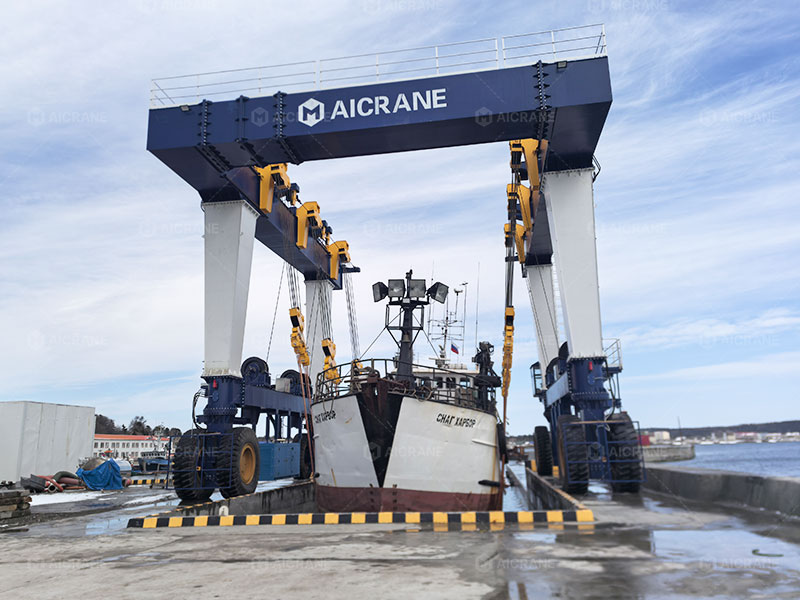
A travel lift (also called a boat hoist or marine travel lift) is a mobile gantry crane designed to lift boats out of the water using slings and transport them on land for maintenance, storage, or launching.
Marine Travel Lift systems are widely used in yacht clubs, shipyards, and fishing ports because they provide flexibility and safe handling for different vessel types.
The most critical specification of a travel lift is its rated lifting capacity, which defines the maximum safe weight it can handle. Choosing the correct capacity ensures:
- Safe lifting without structural failure
- Stable load distribution during hoisting
- Reduced wear on cables, hydraulics, and frames
- Long service life of the equipment
- Protection of expensive vessels
An undersized lift can fail under load, while an oversized system increases unnecessary investment and operational complexity.
2. The Most Important Rule: Always Use “Wet Weight,” Not Dry Weight
One of the most common mistakes in selecting a travel lift or marine boat hoist is using only the boat’s dry weight.
In reality, a boat on a lift is never empty. You must calculate the wet operational weight, which includes:
✔ Dry boat weight
The manufacturer’s base weight of the hull.
✔ Fuel weight
Fuel weighs about 6–6.3 lbs per gallon (≈0.72–0.75 kg/liter).
✔ Water systems
Freshwater tanks, ballast tanks, and live wells can add hundreds of kilograms.
✔ Equipment and gear
Anchors, batteries, fishing equipment, safety gear, and electronics.
✔ Structural modifications
T-tops, radar arches, cranes, davits, and cabins.
✔ Crew or onboard load (in some cases)
Especially relevant for fishing boats in operational conditions.
Example calculation:
- Dry weight: 20,000 lbs
- Fuel: 2,000 lbs
- Gear & equipment: 1,500 lbs
- Water systems: 500 lbs
Total operational weight = 24,000 lbs
Then you must apply a safety margin.
3. The Golden Rule: Add a Safety Margin (20–25%)
Industry standards strongly recommend adding 20–25% extra capacity beyond total operational weight.
Recommended Lift Capacity=Total Boat Weight×1.2
This margin accounts for:
- Miscalculations in weight estimation
- Future upgrades or modifications
- Uneven load distribution during lifting
- Dynamic forces during hoisting and movement
Example:
- Total boat weight: 24,000 lbs
- Safety margin (25%): 6,000 lbs
- Required lift capacity: 30,000 lbs (15-ton class)
This is why most operators round up to the next standard lift rating.
4. Typical Yacht and Fishing Boat Weight Ranges
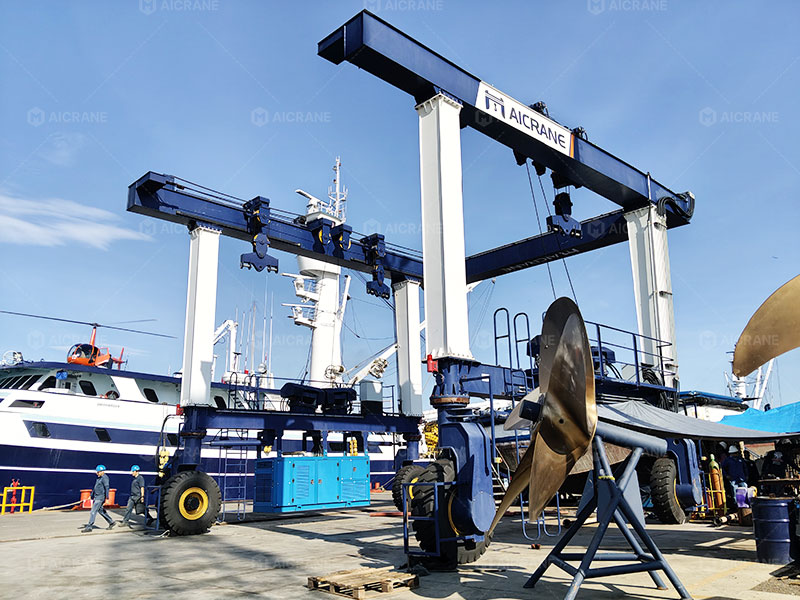
Understanding common vessel weights helps you choose the right category of travel lift more efficiently.
Fishing Boats
Fishing vessels vary widely depending on size and equipment:
- Small fishing boats (16–25 ft): 1–5 tons
- Commercial fishing boats (25–50 ft): 5–20 tons
- Heavy-duty trawlers: 20–50+ tons
Fishing boats often carry additional weight from ice storage, nets, winches, and fuel, which significantly increases lifting requirements.
Yachts
Yachts are generally heavier due to construction materials and onboard systems:
- Small yachts (30–50 ft): 10–25 tons
- Mid-size yachts (50–80 ft): 25–60 tons
- Large yachts (80–120 ft): 60–150 tons
- Superyachts (120 ft+): 150–500+ tons
Luxury yachts also have concentrated weight from interiors, stabilizers, generators, and water systems, making accurate calculation critical.
5. Matching Travel Lift Capacity to Vessel Type
Below is a practical guideline used in shipyards and marinas:
✔ Light Duty Range (10–50 tons)
Best for:
- Small fishing boats
- Small yachts
- Repair yards and boat clubs
✔ Medium Duty Range (50–200 tons)
Best for:
- Commercial fishing fleets
- Mid-size yachts
- Mixed-use marina operations
✔ Heavy Duty Range (200–600+ tons)
Best for:
- Superyachts
- Offshore support vessels
- Large industrial shipyards
Selecting the correct 10 ton to 500 ton travel lift capacity ensures efficient workflow and avoids unnecessary over-specification.
6. Key Factors Beyond Weight
While weight is the primary factor, several other conditions directly affect the required lift capacity and configuration.
Hull shape and lifting points
Different hull designs distribute weight differently. Deep-V hulls, catamarans, and flat-bottom boats require different sling arrangements.
Beam width (boat width)
Wide vessels require wider spreader beam systems, which affect structural load distribution.
Center of gravity
Uneven load distribution can increase stress on one side of the travel lift.
Water and yard conditions
Soft ground, wind load, and slope conditions influence stability requirements.
Frequency of use
High-frequency lifting operations require stronger fatigue resistance and higher safety margins.
7. Common Mistakes When Choosing Travel Lift Capacity
Many buyers underestimate lifting requirements due to planning errors. The most common mistakes include:
❌ Using dry weight only
Ignoring fuel, gear, and water leads to undersized equipment.
❌ Not planning for future upgrades
Many boat owners upgrade to larger vessels over time.
❌ Ignoring safety margin
Operating at maximum capacity reduces equipment lifespan.
❌ Overlooking operational environment
Harsh marine conditions increase stress on structural components.
❌ Choosing based only on price
Lower capacity systems may seem cheaper but increase long-term risk and maintenance costs.
8. Practical Selection Strategy
To choose the correct travel lift capacity, follow this simple workflow:
- Determine dry boat weight
- Add fuel, equipment, and operational load
- Calculate total wet weight
- Add 20–25% safety margin
- Round up to nearest standard lift capacity
- Confirm beam width and hull compatibility
- Evaluate future expansion needs
This ensures both safety and long-term cost efficiency.
9. Final Thoughts
Choosing the right mobile gantry capacity for yachts and fishing boats is not just a technical decision—it directly impacts safety, operational efficiency, and equipment lifespan.
For fishing boats, the key challenge is additional operational gear weight and rugged usage conditions. For yachts, the challenge is complex systems, heavier construction, and higher value risk.
A properly sized system ensures:
- Smooth lifting operations
- Reduced mechanical stress
- Longer equipment lifespan
- Safe handling of valuable vessels
In most real-world applications, operators should always size up rather than size down. A slightly higher capacity lift provides flexibility, future-proofing, and significantly improved safety margins.
If you follow proper weight calculation methods and account for real operational conditions, selecting the right travel lift becomes a predictable engineering decision rather than a guess.