In modern container terminal planning and yard design, the Rubber-Tired Gantry (RTG) crane is the workhorse of yard operations. Selecting its physical dimensions directly impacts the terminal’s physical layout, land utilization efficiency, capital expenditure (CAPEX), and ongoing operating expenses (OPEX). Among the technical specifications of an RTG, the span and lifting height are the two most critical parameters that define yard capacity and operational throughput.
This guide analyzes the practical engineering factors, operational boundaries, and trade-offs involved in selecting the optimal RTG crane span and lifting height for your terminal.
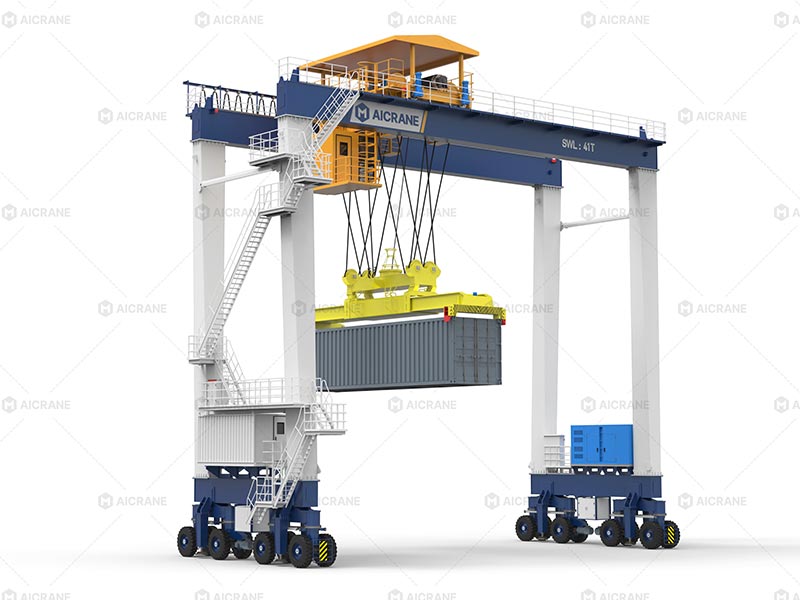
1. RTG Span Selection: Mechanisms and Key Considerations
The span of an RTG is the lateral distance between the centerlines of the travel wheels (or gantry tracks) on both sides. The span determines the width of a single yard block, which dictates the number of container rows and the configuration of the truck lane.
Standard Span Configurations and Space Efficiency
Typical RTG span configurations and their corresponding yard layouts include:
- 23.47 meters (6 Rows + 1 Truck Lane): The traditional industry standard. It allows 6 rows of containers stacked side-by-side with one standard truck lane for yard chassis and external trucks.
- 26.50 meters (7 Rows + 1 Truck Lane): A highly popular choice for terminals with limited land. Adding a seventh container row increases static yard capacity by approximately 16.7% without requiring additional truck lanes.
- 29.50 meters (8 Rows + 1 Truck Lane OR 7 Rows + 2 Truck Lanes): A wide-span configuration. This is typically used in automated RTG yards or high-throughput hubs to ease traffic congestion by providing an extra truck lane or maximizing storage block width.
Core Variables Influencing Span Selection
Selecting a span is not just about maximizing density; planners must balance several structural and operational constraints:
(1) Land Utilization and Terminal Layout
The relationship between total yard width (W_total) and block width (W_block) is governed by:
W_total = n * S + (n-1) * W_aisle + W_clearance
Where S represents the RTG span, and W_aisle is the clearance width required for the crane’s gantry travel path between blocks. While a wider span S increases the storage density within a single block, it reduces the overall number of travel lanes across the terminal, which can sometimes impact traffic flow.
(2) Crane Weight and Wheel Load Limits
An RTG’s structural weight increases with its span. As the span widens, the bending moment at the center of the main girders increases significantly. This requires stronger steel profiles and heavier cross-sections, raising the total weight of the machine. As a rule of thumb, every 3-meter increase in span adds roughly 8% to 12% to the crane’s deadweight. This extra weight increases the wheel loads on the yard pavement, requiring thicker pavement designs and stronger civil foundations, which raises civil construction costs.
(3) Future Automation Readiness
If the terminal plans to transition to semi-automated or fully automated RTG container gantry cranes, the span must accommodate physical safety margins for container tracking sensors, anti-collision systems, and gantry steering devices. Automated operations generally require wider safety clearances between the truck lane and adjacent container stacks, often demanding an extra 0.5 to 1.0 meter of span compared to manual operations.
2. RTG Lifting Height Selection: Mechanisms and Key Constraints
The lifting height is the maximum vertical distance from the ground to the underside of the spreader when fully raised. This determines how high containers can be stacked and how easily the crane can clear existing stacks during moves.
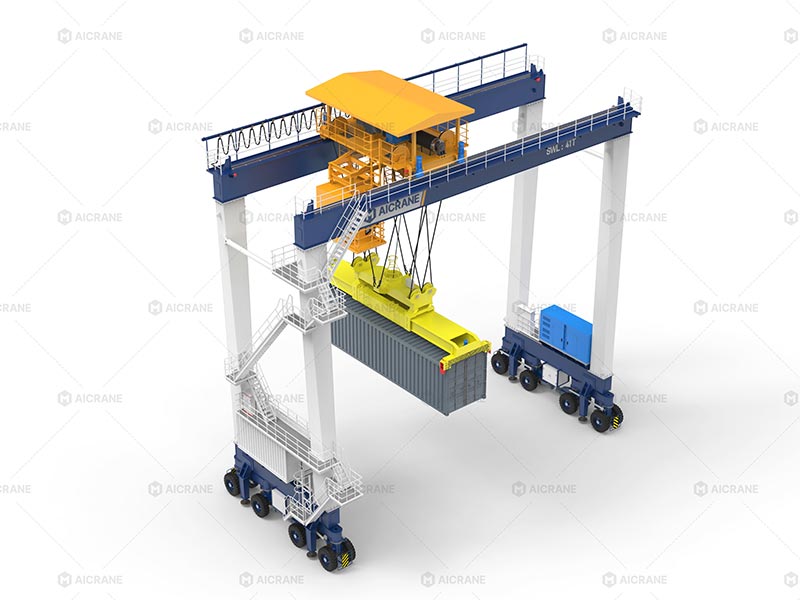
Typical Lifting Heights and Stacking Capacities
RTG lifting heights are commonly described using the “Stack N and Pass N+1” terminology:
| Classification | Typical Height (m) | Stacking and Passing Capability | Best Use Case |
|---|---|---|---|
| 1 over 4 (Stack 4, Pass 5) | ~15.2 – 15.5 | Stacks 4 containers high; clears a 5th container during moves. | Traditional small-to-medium terminals with moderate throughput and standard foundations. |
| 1 over 5 (Stack 5, Pass 6) | ~18.2 – 18.5 | Stacks 5 containers high; clears a 6th container during moves. | The standard configuration for major high-throughput container hubs globally. |
| 1 over 6 (Stack 6, Pass 7) | ~21.0 – 21.5 | Stacks 6 containers high; clears a 7th container during moves. | Mega-ports with extreme land constraints and highly automated terminal operating systems. |
Practical Constraints of Increasing Lifting Height
While taller stacks linearly increase static storage capacity per square meter, they introduce several operational and physical challenges:
(1) Shuffling Rate and Cycle Times
In terminals with highly mixed container flows (import, export, transshipment), stacking containers deeper increases the probability of “shuffling” (moving top containers to access those underneath). The probability of a shuffle (P_shuffle) rises sharply as the maximum stacking height (H) increases:
P_shuffle ≈ 1 – 1/H
Going from a 4-high stack to a 6-high stack causes a sharp increase in extra crane moves. Each shuffle consumes crane cycle time, reducing overall yard productivity. Without a highly capable Terminal Operating System (TOS) to plan smart stacking strategies, simply increasing stacking height can hurt operational efficiency.
(2) Wind Load and Structural Stability
Because RTGs are high-profile, outdoor structures, wind load is a primary safety concern. Taller port gantry cranes have a higher center of gravity and experience:
- Increased Wind Resistance: The wind-facing surface area increases, causing wind loads to grow significantly.
- Overturning Risks: A higher center of gravity requires more robust storm anchoring systems (such as tie-downs, rail clamps, or anchor pins) to secure the crane during severe weather.
(3) Motor Power and Energy Consumption
A higher lift increases the wire rope travel distance on the hoist drums and puts more stress on the vertical structure. To maintain productive cycle times, hoisting speeds must be kept high (typically up to 50 m/min empty and 25 m/min under load). This requires larger hoist motors, which increases fuel or electricity consumption, whether running on diesel generators or electric busbars (E-RTGs).
3. Systematic Selection and Decision Framework
Choosing the right RTG specifications requires balancing space utilization, structural limits, and financial feasibility. Planners should evaluate how changes in span and height affect overall terminal performance.
Sensitivity Analysis and Trade-Off Table
When configuring gantry crane specifications, the following relationships can guide your planning:
| Design Choice | Crane CAPEX | Civil CAPEX (Yard) | OPEX (Energy/Labor) | Static Yard Capacity | Single-Cycle Efficiency |
|---|---|---|---|---|---|
| Increase Span (e.g., 6 rows to 7 rows) | Increases by 5% – 8% | Increases (requires wider or stronger runway beams) | Remains steady | Increases by ~16.7% | Decreases slightly (longer trolley travel distance) |
| Increase Height (e.g., Stack 4 to Stack 5) | Increases by 6% – 10% | Increases significantly (higher wheel loads require deeper foundation work) | Increases (higher hoist power draw) | Increases by ~25% | Decreases (longer hoist times and higher chance of shuffles) |
Recommended Planning Steps
- Define Target Capacity: Calculate the required static TEU storage capacity based on your terminal’s annual throughput goals and average container dwell times.
- Evaluate Foundation Limitations: Measure the bearing capacity of your existing or planned yard pavement. If wheel load capacities are highly restricted, expanding the span (adding rows) is often more cost-effective than increasing the height.
- Analyze Operational Flows: Simulate yard traffic and container moves based on your terminal’s specific mix of import, export, and transshipment cargo to estimate future shuffling rates at different stacking heights.
- Align with Automation Plans: Ensure that chosen dimensions leave adequate physical clearance for the sensors, positioning systems, and automated guided vehicles (AGVs) or road trucks that your terminal intends to support.
4. Conclusion
Selecting the right RTG span and lifting height is not about maximizing parameters to their extremes. Instead, it is about finding the optimal balance between structural safety, civil foundation capacity, operational efficiency, and Life-Cycle Costs (LCC).
- For congested terminals with high-performance Terminal Operating Systems (TOS), a 26.5-meter span (7 rows) paired with a 1-over-5 lifting height offers an excellent balance of high density and high productivity.
- For terminals with weaker soil conditions, high civil retrofitting costs, or a high percentage of transshipments, a lighter 23.47-meter span (6 rows) paired with a 1-over-4 lifting height is often the preferred choice to minimize wheel loads and maintain fast, shuffle-free cycle times.
As ports continue to adopt eco-friendly electrification and automation, selecting physical dimensions that accommodate future technical upgrades ensures your yard equipment remains a long-term, high-value asset.