Rubber Tyred Gantry (RTG) cranes are widely used in container yards, industrial plants, precast yards, and logistics terminals because of their mobility, strong lifting capacity, and ability to operate without rail infrastructure. Unlike rail-mounted cranes, RTGs travel on rubber tires, allowing them to move freely across large operational areas while handling heavy loads efficiently.
As industries demand greater productivity and operational flexibility, many RTG rubber tyred gantry crane designs now incorporate dual hoist systems. Instead of relying on a single lifting mechanism, these cranes use two independent hoists mounted on the trolley or spreader beam. This configuration significantly enhances lifting flexibility, improves load control, and allows operators to handle a wider range of lifting tasks without changing equipment.
This article explores how dual hoist systems work in RTG cranes and explains how they increase capacity flexibility, operational efficiency, and safety.
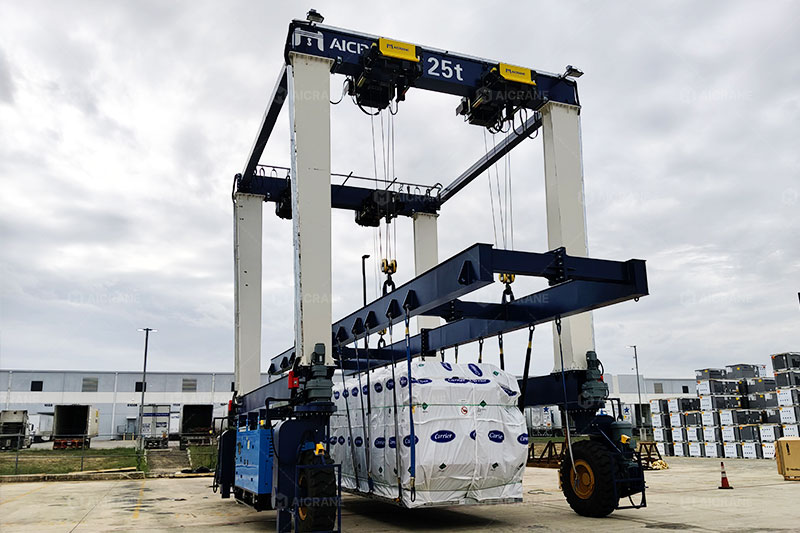
Understanding the Basics of Rubber Tyred Gantry Cranes
A rubber tyred gantry crane is a mobile gantry crane designed to lift and transport heavy loads in outdoor environments such as ports, rail yards, and industrial plants. It typically consists of a large gantry frame supported by multiple rubber tires, a trolley system, a hoisting mechanism, and a power unit.
Unlike fixed gantry cranes that operate on rails, RTGs can move across paved surfaces, making them highly adaptable to changing yard layouts and production environments. Their mobility enables operators to transfer loads between different work zones, trucks, and storage areas efficiently.
Standard RTG cranes are often equipped with a single hoist, which performs all lifting operations. However, for more complex material handling tasks, manufacturers increasingly install dual hoist systems to expand operational capabilities.
What Is a Dual Hoist System in an RTG Crane?
A dual hoist system refers to a configuration where two independent hoisting units are mounted on the same trolley or spreader structure. Each hoist has its own motor, wire rope, drum, and control mechanism.
These hoists can operate in several modes:
- Synchronized lifting – both hoists lift the load simultaneously.
- Independent lifting – each hoist operates separately.
- Differential lifting – hoists move at different heights for tilt control.
- Shared load lifting – two hoists distribute the weight of a heavy load.
By offering multiple lifting modes, dual hoist systems dramatically expand the operational flexibility of RTG cranes.
Enhancing Lifting Capacity Flexibility
1. Handling Loads with Different Weight Requirements
One of the biggest advantages of a dual hoist system is its ability to handle loads of varying weights without requiring multiple cranes.
In traditional single-hoist systems, the crane must be rated for the maximum expected load. However, many lifting tasks involve lighter materials, meaning the full crane capacity is not always necessary.
With dual hoists:
- One hoist can handle smaller loads
- Both hoists can combine for heavier loads
This allows operators to adapt quickly to different lifting scenarios without changing equipment or workflow.
For example, a RTG gantry crane 60 ton with two 30-ton hoists can lift:
- 30 tons using one hoist
- 60 tons using both hoists together
This modular capacity approach improves operational flexibility and equipment utilization.
Supporting Synchronized Lifting Operations
2. Safe Handling of Long or Irregular Loads
Industrial operations frequently involve lifting long or unbalanced loads such as:
- Steel beams
- Precast concrete components
- Wind turbine parts
- Large machinery assemblies
Using a single lifting point for such loads can create instability and uneven load distribution.
Dual hoist systems solve this problem by enabling two-point lifting, which improves load stability and balance. Operators can position each hoist at different points along the load to maintain equilibrium during lifting.
This approach reduces:
- Load sway
- Structural stress
- Risk of load rotation
As a result, dual hoist RTG cranes are particularly effective in precast yards, steel fabrication plants, and heavy industrial sites.
Increasing Operational Efficiency
3. Simultaneous Multi-Load Handling
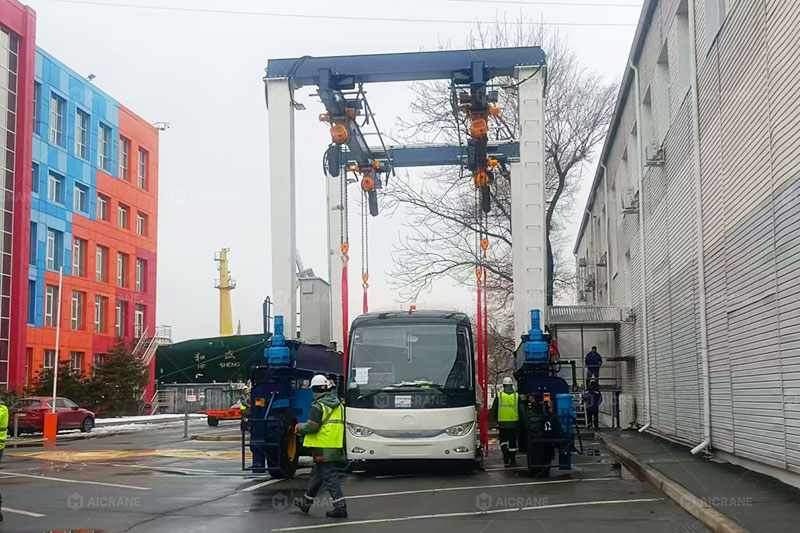
Another advantage of dual hoist systems is the ability to handle two loads in a single crane cycle.
In some operations, the crane can use each hoist independently to lift separate loads. For example:
- One hoist lifts a container or component
- The second hoist lifts another item in parallel
This allows operators to perform multiple handling tasks during the same travel cycle, significantly improving productivity.
In busy yards or production facilities, this capability can:
- Reduce waiting times
- Increase throughput
- Optimize crane utilization
For logistics operations where handling speed is critical, dual hoist RTGs offer a major efficiency advantage.
Improving Load Positioning Precision
4. Advanced Load Control and Alignment
Precise load positioning is essential when placing heavy components into tight spaces, such as:
- Assembly lines
- Storage racks
- Transport vehicles
- Construction supports
Dual hoists allow operators to adjust the height of each lifting point independently. This provides greater control over load orientation and tilt.
For example:
- One hoist can raise slightly higher than the other.
- This tilts the load for accurate alignment.
This capability is particularly useful when installing large structural components or positioning prefabricated elements.
Modern RTG cranes often integrate PLC control systems and variable-frequency drives that allow smooth, precise hoisting and load positioning.
Combined with dual hoists, these technologies significantly improve lifting accuracy.
Increasing Operational Safety
5. Better Load Distribution
Heavy loads can place enormous stress on lifting equipment and crane structures. Dual hoist systems distribute the load across two lifting points, reducing stress on each individual hoist.
This balanced load distribution provides several safety benefits:
- Reduced risk of wire rope overload
- Lower structural stress on the crane trolley
- Improved lifting stability
- Reduced load swing
Balanced lifting also protects the crane’s mechanical components, extending service life and reducing maintenance costs.
Supporting Specialized Industrial Applications
Dual hoist RTG cranes are especially valuable in industries that handle large, heavy, or complex loads.
Precast Concrete Production
Concrete beams and panels are often long and heavy. Dual hoists allow safe two-point lifting during production and transportation.
Steel Fabrication
Steel structures such as girders and trusses require balanced lifting to prevent bending or twisting.
Shipyards
Large ship components often require precise positioning and alignment.
Heavy Equipment Manufacturing
Dual hoists allow accurate handling of large mechanical assemblies during production.
Because RTG cranes can move freely across industrial sites without rails, they are ideal for handling these materials across large work areas.
Supporting Future Capacity Expansion
Another key benefit of dual hoist systems is scalability.
Instead of investing in a larger single hoist gantry crane, companies can upgrade to dual hoists to increase lifting capability without replacing the entire crane system.
Benefits include:
- Lower capital investment
- Easier upgrades
- Greater operational flexibility
- Improved equipment utilization
This makes dual hoist RTG cranes a smart long-term investment for growing industrial operations.
Integration with Smart Crane Technologies
Modern RTG cranes increasingly incorporate advanced technologies that enhance the effectiveness of dual hoist systems.
Examples include:
- Anti-sway control systems
- Load monitoring sensors
- Automated positioning systems
- Remote operation and automation
These technologies improve safety, precision, and operational efficiency. Together with dual hoist mechanisms, they enable cranes to perform complex lifting operations with minimal operator intervention.
Conclusion
Dual hoist systems significantly expand the operational capabilities of rubber tyred gantry cranes. By integrating two independent lifting mechanisms, RTG cranes gain the flexibility to handle different load sizes, perform synchronized lifting, improve load control, and increase overall productivity.
Compared with traditional single-hoist configurations, dual hoist systems provide several key advantages:
- Flexible lifting capacity for different load weights
- Improved stability for long or irregular loads
- Increased operational efficiency through simultaneous lifting
- Greater positioning precision for complex installations
- Enhanced safety through balanced load distribution
As industrial material handling becomes more demanding, these capabilities are becoming increasingly important. Dual hoist RTG cranes offer a powerful solution for businesses seeking higher efficiency, greater lifting flexibility, and improved safety in modern logistics yards, manufacturing plants, and construction environments.
For companies planning new crane installations or upgrading existing RTG systems, adopting a dual hoist configuration can provide significant operational advantages and long-term value.