For any marina, shipyard, or boat repair facility, purchasing a 50-ton mobile boat hoist (commonly known as a travel lift) is a major milestone. This machine is not just the heavy-duty “muscle” of your yard; it is the ultimate ticket that dictates which vessels you can lift and how much revenue you can bring in.
However, based on our years of helping shipyard owners work with premium crane manufacturers, we have noticed a risky trend: buyers often spend 90% of their energy focusing on lifting capacity (is 50t enough?) and the price tag, while completely overlooking the one physical measurement that can make or break their entire investment—Inside Clear Width (ICW).
Make it too narrow, and you will watch lucrative catamaran and wide-beam yacht owners sail straight to your competitors. Make it too wide, and your machine price will skyrocket, your concrete runway installation costs will double, and maneuvering a massive footprint in a tight yard will become an operational nightmare.
Today, we will share practical advice on how to select the perfect Inside Clear Width for your 50 ton travel lift, helping you avoid a costly mistake that could drain your bottom line.
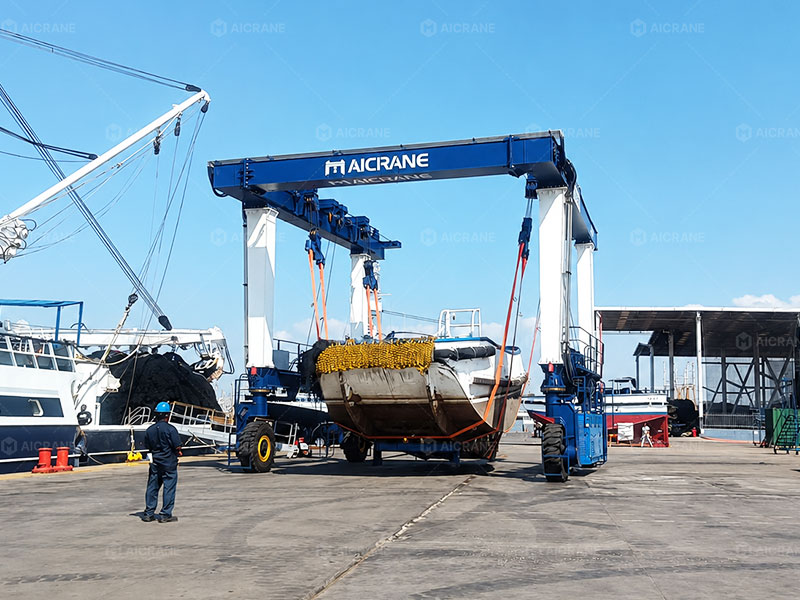
1. What is Inside Clear Width (ICW), and Why is It a “Safety Red Line”?
In simple terms, Inside Clear Width (ICW) is the narrowest horizontal distance between the structural steel columns of the lift (usually measured from the inside of the tires or the inner protective guards).
A common mistake made by first-time buyers goes like this:
“The widest boat (beam) I plan to lift is 5 meters. Therefore, a boat travel lift with an ICW of 5.2 meters should be plenty, right?”
The answer is a resounding NO. If you order a machine with that mindset, your very first lift will result in scratched hull gelcoats, pinched slings, or a complete inability to lift the boat safely.
In real-world dockside operations, the required ICW is not just the boat’s beam. It must leave enough breathing room for daily rigging. Here is a simple rule of thumb:
Required ICW = Maximum Vessel Beam + Thickness of Slings & Pads + Fenders + Safety Buffer
- Maximum Vessel Beam: This must include rub rails, outriggers, or any other permanent attachments on the side of the hull.
- Slings and Protective Pads: The heavy-duty slings used for a 50t lift are thick. Once you add protective pads, they take up a noticeable amount of space on both sides.
- Safety Buffer: When lifting a boat in the water, wind and currents will cause the vessel to sway. Operators need at least 30 cm to 50 cm of safety margin on each side to safely align and lift the boat.
Without these extra margins, even being off by 10 centimeters will render your brand-new machine useless for the targeted fleet.
2. Don’t Fall into the “Average Beam” Trap: Boats Are Getting Wider!
Historically, a 50-ton travel lift was primarily used to haul traditional fiberglass fishing boats or cruisers ranging from 50 to 65 feet in length. These boats had very predictable profiles, with beams rarely exceeding 4.5 to 5.5 meters.
However, yacht designs have shifted dramatically over the past decade:
- The Rise of Catamarans: Modern sailing and power catamarans make up a massive percentage of the sub-50-ton weight class. A catamaran that is only 50 feet long can easily feature a beam of 7.5 to 8 meters.
- Wide-Beam Monohulls: To maximize interior living space, modern boat builders are designing shorter but substantially wider hulls.
If you purchase a standard 50t lift with a traditional 6.0-meter ICW, you are locking yourself out of the high-margin multihull repair market. In the yard service industry, catamaran owners are typically charged 50% to 100% premiums for haul-outs and yard storage compared to standard monohulls of similar weight.
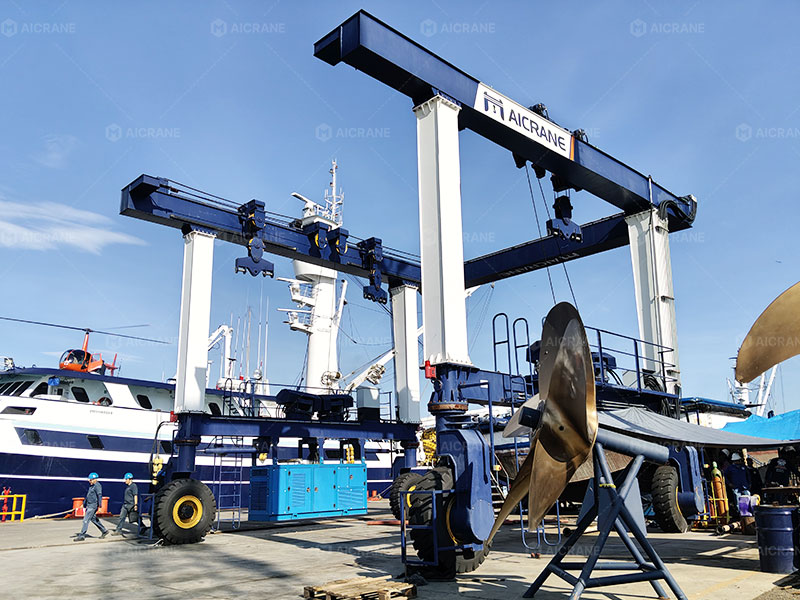
3. Going Too Wide? The “Weight & Cost” Penalty
If wide boats are the future, why not just order an ultra-wide 50-ton lift with a 10-meter ICW to cover all bases?
Because over-specifying width comes with severe consequences:
A. The “Leverage” Effect: Wider Means Heavier and Much More Expensive
Structurally, the top cross beam of the mobile boat hoist acts like a carrying pole. The wider the span between the side columns, the more structural stress is concentrated in the middle of the beam under load. To prevent the beam from bending when lifting 50 tons, the manufacturer has to use much thicker, heavier steel plates and larger structural frames. This causes the machine’s deadweight to skyrocket. A heavier machine requires larger hydraulic motors, thicker wire ropes, and more expensive heavy-duty tires, driving up the purchase price exponentially.
B. Astronomical Pier and Runway Costs
This is the hidden expense that catches many marina owners off guard. Travel lifts run on two parallel concrete piers (runways) extending over the water.
- If your lift is wider, the center-to-center distance of your concrete piers must increase.
- Building wider runways over water means drilling more load-bearing piles into the seabed. In marine construction, the cost of driving extra underwater piles can easily dwarf the cost of the travel lift itself!
C. Less Yard Space and Tight Corners
In a crowded shipyard where space equals revenue, a wider machine footprint means you need wider travel lanes. This reduces the number of dry-storage bays you can fit in your yard, lowering your overall efficiency.
4. How to Choose Your Perfect ICW (A 4-Step Guide)
To find the perfect sweet spot between lifting capability and construction costs, use this systematic approach:
[Step 1: Check Target Fleet] ──> [Step 2: Check Pier Constraints] ──> [Step 3: Apply Rule of Thumb] ──> [Step 4: Consider Variable Width]
Step 1: Analyze Your Local Market
Conduct an audit of the boats within a 50-mile radius of your yard that weigh under 50 tons.
- If monohulls make up 95% of your target market, a standard 6.0 m to 6.5 m ICW is the most cost-effective, high-ROI configuration.
- If you intend to capture the premium catamaran market, you must look into customized dimensions of 8.5 m to 9.5 m or wider.
Step 2: Measure Your Existing Runways
Do not order a machine without thoroughly mapping your current concrete pier width. If runway modification is required, consult a local marine contractor early to get a realistic cost estimate.
Step 3: Use the “Plus One Meter” Rule of Thumb
Always add a minimum safety buffer of 1.0 meter in total clearance (0.5 meters on each side of the boat’s beam).
- Example: If your target catamaran has an 8.0 m beam, do not buy an 8.0 m wide hoist.
- Calculation: 8.0 m (Beam) + 0.3 m (Slings) + 0.7 m (Operator Margin) = 9.0 m (Minimum required ICW).
Step 4: Explore “Variable Width” Options
If you want the maneuverability of a narrow machine for monohulls but still want to tap into the catamaran market, ask premium manufacturers about variable-width or telescopic frames. While the upfront cost is higher, the versatility it offers can provide the best of both worlds.
5. Case Study: A Very Expensive Lesson
In 2022, Dave, the owner of a busy Florida-based boatyard, decided to replace his aging yard hoist. In an attempt to save approximately $35,000 in upfront equipment purchase costs, Dave declined the manufacturer’s recommendation for a custom 6.8 m wide machine, opting instead for a standard 5.8 m ICW 50-ton travel lift.
Dave’s logic was simple: “90% of the boats we haul are under 5.2 meters wide. Why pay more for extra steel?”
Within the first year of operation, two major incidents redefined his business:
- A local catamaran club looking for a long-term haul-out partner approached Dave with a highly profitable contract. Because Dave’s machine was too narrow to accommodate their 6.5 m beam multihulls, he had to decline. The contract – worth roughly $120,000 annually – went straight to his competitor just 3 miles away.
- During a routine haul-out of a wide-beam motor yacht in windy conditions, a sudden gust caused the vessel to sway inside the launching well. The boat’s side rubbed against the travel lift’s structural column, causing severe gelcoat gouges. Dave’s insurance paid $18,000 for the repair, and the yard’s reputation took a major hit.
Just two years later, Dave is now forced to sell his near-new travel lift at a heavy depreciation loss and re-order a wider unit. The replacement and downtime costs are multiple times the $35,000 he originally saved.
Conclusion
In the configuration checklist of a 50-ton travel lift, Inside Clear Width is not a detail you can compromise on—it is the physical boundary of your shipyard’s earning potential.
Before signing the purchase agreement or sending the wire transfer, make sure you have evaluated your local fleet profiles, audited your existing pier geometry, and anticipated future design trends. If you are struggling to find the right balance, contact Aicrane expert engineering consultants today. We will help you run a complete yard-compatibility analysis to ensure your new investment yields maximum returns for decades to come.